

Native Subscriptions on NEXT:
A Deep Dive
Discover how NEXT's native subscriptions give DTC brands zero-fee recurring revenue, smarter retention, and full control of the customer experience
A loyal repeat customer is worth roughly seven times a one-time buyer in most DTC verticals, making subscription ecommerce a non-negotiable for any brand serious about lifetime value. In fact, the brands compounding the fastest growth are the ones converting first-time buyers into recurring ones at scale. Next Commerce was built to make that conversion the default state of a DTC business, with a subscription engine wired directly into the platform rather than rented from a third-party app.
Most DTC brands run their highest-margin revenue stream through software that was bolted onto the storefront long after the fact, and the cracks show up everywhere: compounding rev-share fees, failed payments that leak revenue, clunky customer portals, and offer logic so rigid that every promotional test requires a developer. This type of imperfect system is bound for error.
In contrast, NEXT’s native subscriptions solve each of those problems at the architecture layer while also giving merchants tremendous flexibility to create attractive offers.
The Hidden Cost of Third-Party Subscription Apps
One of the driving forces behind NEXT was that subscription ecommerce has outgrown the tooling most brands run on.
The standard setup is fundamentally flawed: your platform can’t process recurring orders natively, so you install an app that takes a small percentage cut on every renewal. That fee feels negligible at first and then quietly compounds into a six-figure annual tax once the program actually works.
Beyond the fee structure, there’s the revenue risk of operating in an un-unified system. When inventory, tax, fulfillment, and analytics each need their own bridge to see what’s happening with subscription orders, you’re bound to run into one of these common pitfalls:
- New subscriptions are processed without sufficient inventory
- Failed payments get retried with blunt logic, leading to involuntary churn
- Customers can’t delay a shipment or change their cadence in a third-party portal, so they cancel
Ultimately, teams may make erroneous product or marketing decisions based on issues with their subscription engine, and that’s an unsustainable way to operate.
How do Native Subscriptions Work on NEXT?
NEXT’s native subscriptions engine is part of the platform - not synced to it, not bolted onto it. In that sense, a renewal order acts the same as a one-time order. Inventory sees it. Tax sees it. Fulfillment sees it. Analytics see it. There is no sync delay, no data drift, and no parallel reporting system to reconcile at the end of the month.
Additionally, running subscriptions on NEXT helps you earn and keep more of your revenue in a few major ways. Chiefly, NEXT merchants can run subscriptions at no extra cost – no platform fees, no transaction fees. You keep everything you earn from subscriptions.
And because subscriptions are part of NEXT’s architecture, you can leverage other great NEXT features like Smart Decline Salvage, which, on average, recovers up to 13% of true MRR of subscriptions that would have otherwise churned. Similarly, merchants can allow their customers to manage their subscriptions through dedicated customer accounts, with self-service options for modifying their subscription rather than outright canceling.
That same architectural advantage extends to where subscriptions live in the customer journey. Whether a subscriber signs up through the main storefront or through a dedicated funnel built in NEXT’s Campaigns App, the subscription logic is identical. The same package, the same offer rules, the same renewal cadence, the same customer portal. Merchants don’t have to maintain two parallel systems or worry that a subscriber acquired through a funnel will behave differently from one acquired through the PDP.
Setting Up Subscriptions on NEXT
Any product, physical or digital, bundled or as a single unit, can be offered as a subscription. Each subscription unit on NEXT is called a “Package” and contains a product(s), a quantity, a price, and a recurring schedule. The list of variables includes:
- Interval type - Days, weeks, or months.
- Interval count - Open-ended rather than locked to preset cadences. A coffee brand can run 21-day delivery; a supplement brand can match a 30-count bottle to a 30-day cycle.
- Package Price - The amount charged on the initial order.
- Recurring Price - The amount charged on every renewal afterward, configurable independently from the initial Package Price.
- Offer rules - Discounts, coupons, and promotional logic applied to the Package — including subscription-only discounts and first-order-only discounts.
- Customer portal permissions - Which self-service actions to expose to subscribers, including changing the next renewal date, adjusting the schedule, updating payment methods, and editing shipping addresses.
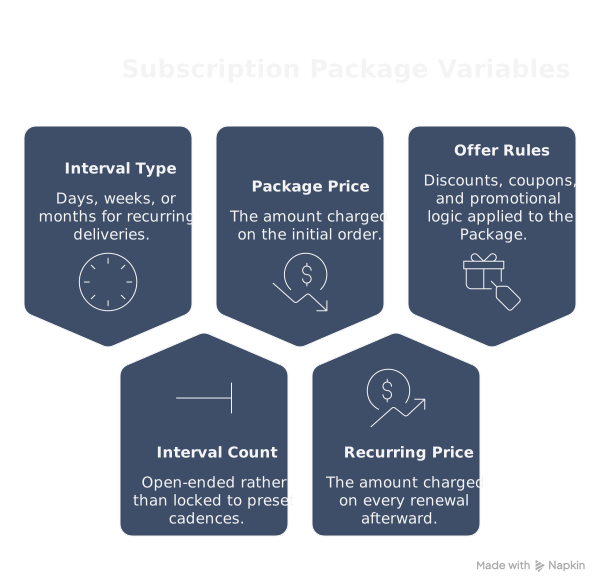
NEXT enables marketers to get creative and set up subscription offers. The split between the Package Price and the Recurring Price allows introductory pricing, free trials, prepaid bundles, and step-up cadences without any custom development. Marketing can test offer mechanics at scale, anywhere in the customer journey, without filing engineering tickets.
Build for Retention, Not Just Acquisition
By treating subscriptions as a core feature of the platform, NEXT removes the friction that quietly limits most subscription services. Merchants keep the revenue that would otherwise go to third-party tooling, recover a meaningful amount of involuntary churn, and run complex offers that would normally require engineering work.
Whether you are currently serving a set of subscribers or are looking to fold subscription offers into your sales strategy, only NEXT can provide you with the platform-level support you need to scale and grow your business as you see fit.
About Next Commerce
Next Commerce helps ecommerce brands turn paid traffic into higher-value customers. It gives merchants agentic tooling to launch and iterate on customer journeys faster, with more control before and after purchase across offers, checkout flows, one-click upsells, subscriptions, payment routing, and recovery to improve CVR, AOV, and LTV.